
CFRC Main Release Paths
Central Florida Reception Center Main Unit is part of the FDC system. Reception and classification help FDC receive sentenced people, review records, assign classifications, and route them within state corrections. Arrival from Orange County means county custody ended by transfer into FDC custody. It does not mean the person was released from incarceration.
A later move from Main to East, South, or another FDC institution is also a transfer. The inmate population record should continue to show state custody with a new location or status. A true discharge is different. FDC's Inmate Release Information Search preserves a release date and related state record for people released from FDC or scheduled for release. If community supervision follows, the separate supervision database shows its type, status, dates, and office.
Match CFRC Main Release Records
Use the DC number as the stable key across population, release, supervision, OBIS, and record-request results. Then compare the full name and aliases, sentence county, case, admission date, and incarceration history. A shared name is not enough. When the person has more than one FDC episode, match the release date to the correct admission and sentence rather than lifting an older discharge into the current case.
Search CFRC Main Releases
Start at the FDC Offender Search menu. The menu separates current inmate population, inmate release, community supervision, and absconder records. Choosing the correct database prevents a common error: looking only for a current prisoner when the question concerns a past release.
- Use the inmate population search first. Enter the six-character DC number when known, or search by name and available identity fields.
- Open the matching detail. Check the DC number, location, status, sentence and offense data, county or case, and the public Current Release Date when present.
- If the person is no longer in population results, open the Inmate Release Information Search. Search by DC number first, then by name or release-date range.
- Read the completed Release Date and state history. If the record instead shows a future Current Release Date, treat it as a projection that may change.
- Use the community-supervision search when probation, parole, conditional release, or another FDC supervision type may follow prison.
FDC states that its release search updates nightly and excludes county jail and county probation data. The Orange County live roster is therefore the wrong archive for CFRC. A no-match should prompt identifier checks, alternate spellings, a records request, and review of any receiving agency named in the official record.
CFRC Main Release Fields
The DC number is the best link across FDC searches. Names can be shared, misspelled, or recorded as aliases. After opening a result, compare identity details with the sentence, county, case, and incarceration history. Do not join records solely because two people have the same name.
| FDC field or search | Meaning for CFRC Main |
|---|---|
| Current location/status | Shows whether FDC still lists the person in custody and where. |
| Current Release Date | FDC's public label for a scheduled date that can change. |
| Release Date | Completed state release date on a released-person record. |
| Incarceration history | Helps distinguish reception, institution moves, and release episodes. |
| Supervision type/status | Shows whether an FDC community obligation follows prison. |
Florida law calls the gain-time projection a tentative release date, even though the public detail uses Current Release Date. Gain time, court credit, sentence corrections, forfeiture, new sentences, detainers, and other legal changes can affect the projection. A past Release Date is the stronger evidence that FDC recorded the state release event.
The release detail may also show sentence and incarceration history. Those sections help connect the person to the correct Florida case and distinguish an old release from a current prison episode. A person can have more than one custody period. Read the event dates in sequence and do not reuse an earlier Release Date as the answer for a later sentence.
Note: An FDC release date confirms departure from state custody, but another agency may take custody under a separate hold.
CFRC Main Release Contact
The Main Unit's official institution profile and FDC records route serve different purposes. The profile confirms the institution and location. FDC Offender Search supplies public status and release data. A targeted FDC public-record request is the fallback for a discharge document or movement record not shown in the public interface.
Central Florida Reception Center Main Unit
Agency: Florida Department of Corrections
Address: 7000 H.C. Kelley Road, Orlando, FL 32831
Records: Use the FDC public-record request process
Search: FDC population, release, and supervision databases
For a records request, identify the DC number, exact document, institution, event, and date range. Ask for the releasable portion if exemptions apply. Section 945.10 protects categories such as medical, victim, and security-sensitive information, so a public search result is not proof that the whole prison file is open.
CFRC Main Institution Profile
The official CFRC Main profile is the direct government source for the institution's current public description and contact details.
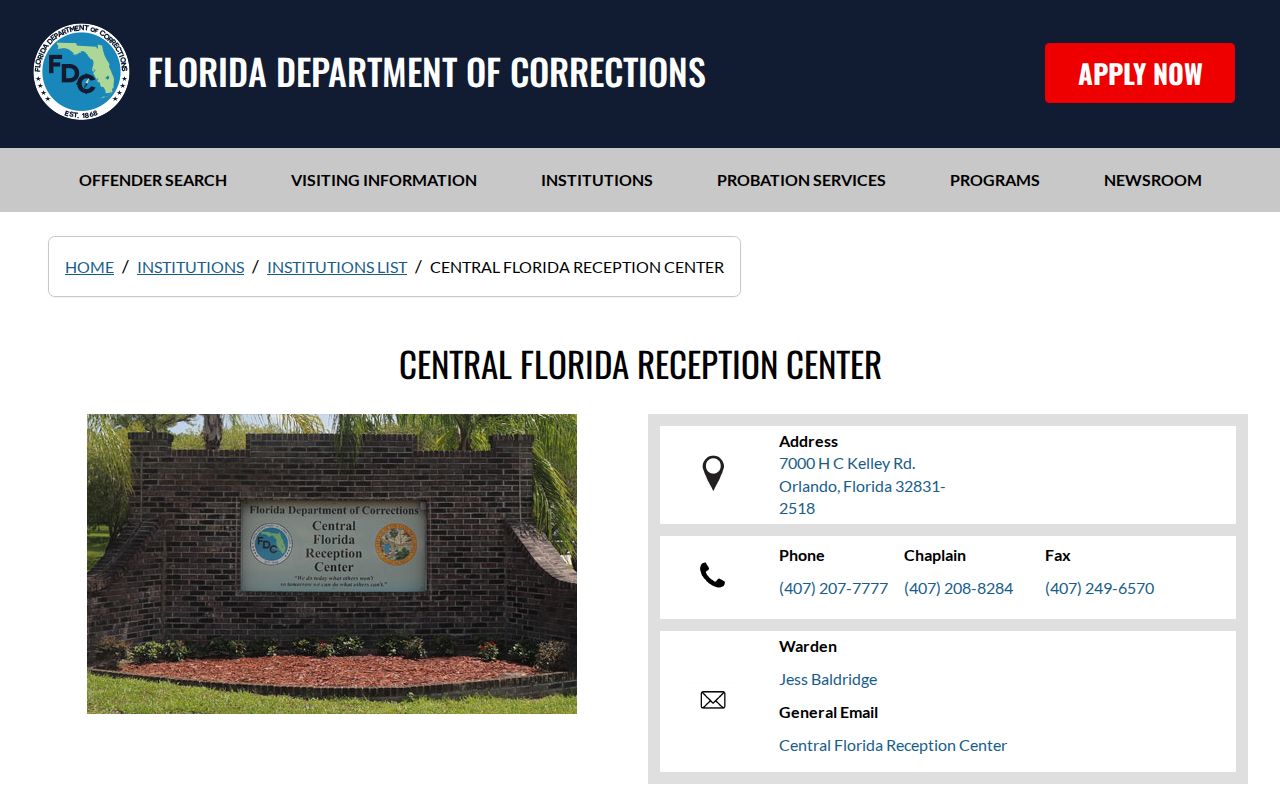
The profile confirms that CFRC Main belongs to FDC. This matters because the county and state systems answer different questions. Orange County records document the county transfer event. FDC documents reception, classification, later prison placement, projected release, completed state release, and state community supervision.
FDC also publishes monthly OBIS data for research and public-record access, including released-inmate tables dating from October 1, 1997, subject to sealed, expunged, and confidential removals. OBIS can help when the person interface is too narrow, but it remains a state dataset. It does not contain Orange County jail-only releases and should not replace a targeted event record when exact confirmation is needed.
Reception does not promise that a person will serve the rest of a sentence at Main. Classification may lead to another FDC assignment. A family member who sees a location change should search the current population record again before interpreting it as a release.
Request CFRC Main Records
Use the FDC public-record request process when Offender Search does not show enough detail. A narrow request can ask for the movement history around CFRC Main, the release or discharge event, and the public portion of the document authorizing or recording it. Include the DC number and a defined date range.
The request should distinguish three events: admission to CFRC from Orange County or another source, transfer from Main to another FDC location, and final release from FDC. Asking for “all records” can slow review and gather protected material that is not needed. A precise request gives the custodian a clear event to locate and redact.
When the requested date was only projected, ask for the sentence computation or public release-date basis that FDC can lawfully provide. The 85-percent rule is a statutory floor for covered modern sentences, not a universal calculator. Offense dates, mandatory terms, consecutive or concurrent sentences, life terms, disciplinary forfeiture, restoration, and sentence corrections can change the result. The agency's current record controls.
- Reception
- FDC intake and classification after entry into state custody.
- Transfer
- Movement within or between correctional systems while custody continues.
- Tentative release date
- The statutory term for a projected FDC date affected by lawful credits and changes.
- Discharge
- The recorded end of the state custody or supervision status identified by FDC.
Trace CFRC Main Discharge
After a completed FDC release, check the community-supervision database when the state record or court history indicates supervision. Active means FDC lists the person as supervised in the community. Active Suspense means the person is temporarily unavailable for direct supervision because of custody or another setting while the officer monitors status. Absconder has a separate meaning and warrant process. Use the exact official label.
A federal, county, or immigration hold can create another custody step. An FDC release does not prove that no other agency received the person. The release record, detainer field when public, and receiving locator establish the path. The Orange County released inmate search maps those county, state, federal, and ICE boundaries.
The final statement should name the system and event: currently in FDC custody, transferred within FDC, scheduled for release, released from FDC on a recorded date, or active on community supervision. That precision is more useful than saying only that someone “left CFRC.”
If the FDC release date and a court date differ, preserve both. The court record shows the sentence or later judicial action. FDC's record shows how the state carried out custody and release. A conflict should be referred to the record owners with the DC number and case number, not resolved by choosing the date that appears more favorable.