
Orange County Supervision Records
Release from the Orange County Booking and Release Center answers only the custody question. A court or state record may place the person on probation, pretrial release, community control, parole, conditional release, or another form of supervision. Each term has a distinct legal source. Calling all of them parole hides who controls the case and where a current status can be confirmed.
The Florida Department of Corrections maintains the public community-supervision search for state cases. The Florida Commission on Offender Review controls parole and several other release decisions. Orange County Corrections operates county probation and pretrial services. Begin with the court case, DC number, or release paper. Then match the agency, supervision type, start date, expected end date, office, and current status.
Orange Parole Versus Probation
Parole is not the usual release path for modern Florida sentences. It is a discretionary Commission mechanism for a limited legacy or otherwise eligible population. Probation generally comes from a court sentence and can begin without a prison term or follow a jail term. Conditional release is a separate post-prison mechanism under Florida Statutes § 947.1405.
| Supervision | Who orders or manages it | Where Orange County records appear |
|---|---|---|
| State probation | Court order, supervised by FDC | FDC community-supervision result and court docket |
| County probation | Orange County court and Community Corrections | Orange Clerk case and county probation office |
| Parole | Florida Commission on Offender Review | FCOR decision plus FDC supervision result |
| Conditional release | Statutory release overseen through FCOR/FDC | Commission order and FDC status |
| Pretrial release | Court order before case disposition | Orange Clerk docket and Pretrial Services |
| Community control | Court-ordered intensive community supervision | FDC supervision result and sentencing order |
“Released” can therefore coexist with “active supervision.” It means secure custody ended, not that every condition ended. The record must be read through its listed termination or discharge event.
Verify Orange County Post-Release Supervision
A DC number is the strongest key for an FDC record. For county supervision, the Orange County criminal case number is often more useful. Names can return similar people, so compare the court, offense, dates, and location before treating a result as a match.
- Open the FDC community-supervision search for a state probation, parole, conditional-release, or community-control case.
- Search by DC number when known, or use the full name and available filters. Open the record rather than relying on the result list.
- Verify the supervision type, current status, begin date, scheduled termination, office or location, and offense or case information.
- Check the Orange Clerk criminal docket for the signed sentence, modification, violation, or termination order.
- For county probation or pretrial release, contact Orange County Community Corrections instead of assuming the FDC search includes it.
- If the status is Absconder or a warrant is mentioned, verify it through the issuing authority and do not approach the person.
The FDC result is an agency status record, not proof that every court obligation has ended. Likewise, a court order may need time to reach the supervision database. Compare identifiers and dates across both sources.
The official FDC search form shows the state-supervision fields used for this check.
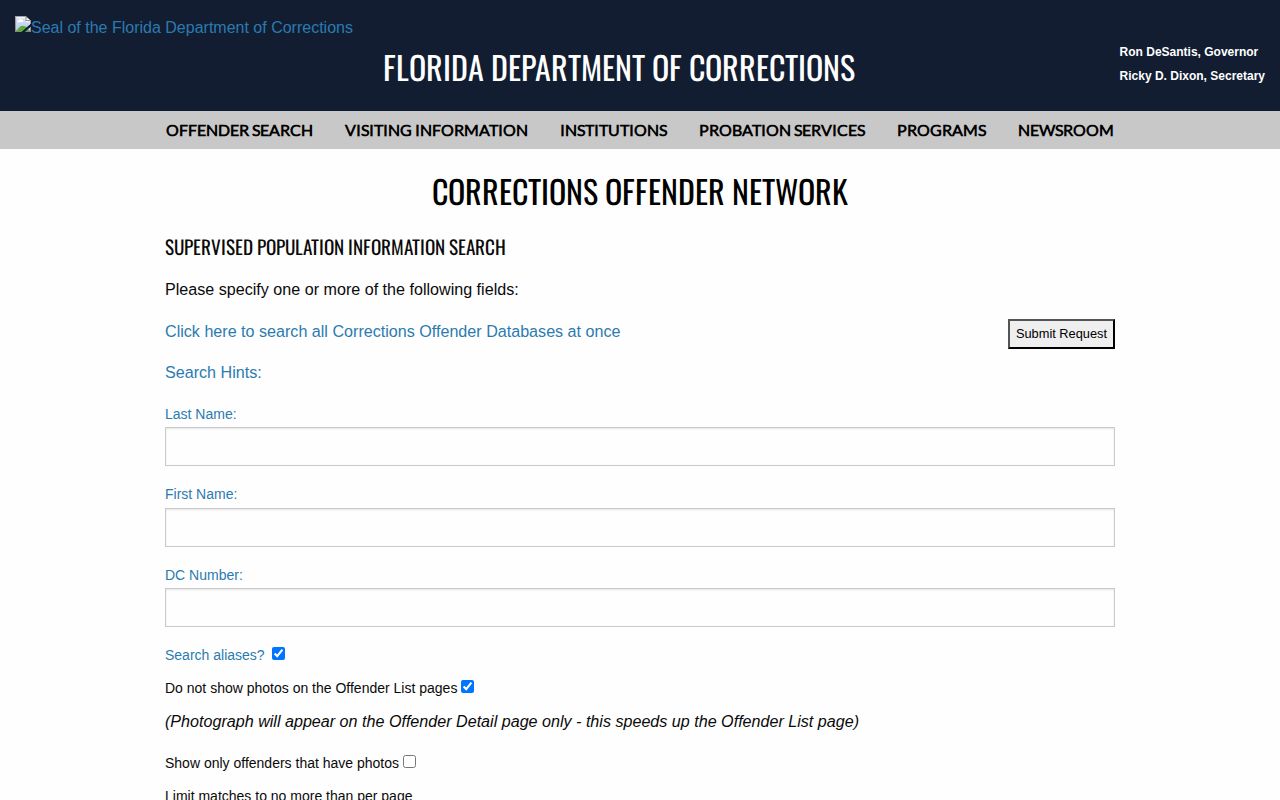
The form does not include Orange County-only probation or pretrial cases, which stay with the county court and Community Corrections.
Read Orange Supervision Status Labels
FDC defines Active as supervision in the community. Active Suspense means the person is temporarily unavailable for direct supervision, often because the person is in jail or another facility, while the officer continues to monitor status. Absconder means the person's whereabouts are unknown and a violation warrant has issued. Those labels should not be reduced to a simple yes-or-no release answer.
- Active
- The person is recorded as supervised in the community.
- Active Suspense
- Direct supervision is interrupted while another custody or location issue is monitored.
- Absconder
- The person is unavailable to supervision and a violation warrant is recorded.
- Discharge
- The agency records completion of the identified supervision term.
- Revocation
- The supervising authority ends release status through the applicable legal process.
FDC says its supervision and absconder datasets receive complete weekly refreshes, while termination dates and location changes update nightly. A recent order may not appear at once. For a time-sensitive issue, use the listed office and the signed court or Commission order.
Orange County Supervision Offices
Orange County has two important supervision routes. State felony supervision for Orange and Osceola Counties is served by FDC's Orlando Circuit Office. County probation, pretrial diversion, and pretrial release belong to the Orange County Corrections directory. Sending a county-only matter to FDC can produce a false “not found” result.
FDC Orlando Circuit Office, Circuit 92301 Meeting Place
Orlando, FL 32814
Phone: 407-212-2143
Email: orlando.cir@fdc.myflorida.com
Serves Orange and Osceola Counties Orange County Community Corrections
3723 Vision Boulevard
Orlando, FL 32839
Administration: 407-836-3570
County probation, pretrial release, diversion, and central intake: 407-836-3000
Pretrial Services: 407-254-7500
Before calling, have the person's full booked name, DC number or Orange County case number, and the supervision type shown in the order. Office staff can route a record question more reliably when those identifiers are available.
Orange County Parole Decisions
The Florida Commission on Offender Review publishes a monthly voting calendar and person-specific agendas. Agenda headings such as Initial, Subsequent, Effective, Extraordinary, Supervision Review, or Conditional Medical Release describe the proceeding. They are not the outcome. A favorable step also is not the same as physical release from FDC.
Use the FCOR voting calendar and the detailed schedule to locate the proceeding. For final orders from July 15, 2015 forward, the Commission directs users to Florida Agency Indexed Orders with the DC number entered as the agency case number. Older or missing material can be requested from FCOR. Pair the final order with FDC's actual release date and supervision result.
Orange Parole Eligibility Timing
Florida effectively ended ordinary parole for offenses committed on or after October 1, 1983, apart from limited legacy and offense-specific groups. A sentence length alone does not establish eligibility. The Commission record and governing law must identify the person as parole eligible before a hearing date is treated as part of a possible release path.
Florida Statutes § 947.16 sets initial-interview timing for eligible sentences. It provides different periods for an indeterminate or short term, a minimum term over three but under six years, a term of six years or more, a life sentence, and a youthful-offender sentence. Those periods schedule an interview. They are not promised release dates, and they do not show that the Commission granted parole.
FCOR says in-person parole hearings normally take place on Wednesdays, with some follow-up matters handled on Thursdays by video or telephone. The monthly calendar can vary. Check the published date and person-specific agenda instead of assuming that every Wednesday is a hearing date. After action, obtain the final order to learn whether the Commission established, modified, continued, delayed, revoked, or clarified a release-related decision.
The sequence has three separate proofs: eligibility and Commission action, FDC's completed physical release, and the community-supervision status that follows. A presumptive parole release date can change during review. Only the later FDC and supervision records show whether the person left prison and under what active conditions.
Orange Absconder and Warrant Checks
FDC maintains a separate absconder and fugitive search. An Absconder label describes the supervision agency's current status and a violation warrant. It is not a new conviction. The warrant, alleged violation, and any later court or Commission action remain separate records.
Search with the DC number when possible, then compare the photograph, identity, office, and case data. Confirm any active warrant through the issuing authority. Never use a public result as a reason to confront or follow someone. For county probation, consult the Orange Clerk docket and Community Corrections because FDC's absconder list does not cover every county case.
Orange Release Health Continuity
Orange County's Reentry and Transitional Services function has worked with community providers before release. County oversight material describes a voucher for a free 30-day medication supply for each released person. It also says people treated for opioid detoxification receive Narcan with their property and that free Narcan is available in the Booking and Release Center lobby.
These health-continuity steps are not forms of supervision and do not appear as an FDC status. They are local release support. A person may receive them whether or not state or county reporting follows. Verify supervision through the proper agency record rather than inferring it from a release service.
Orange Release Property Corrections
The Booking and Release Center inventories property at intake and returns it during release processing. Orange County publishes 407-254-7615 for Property Information. A missing property issue belongs with that function, while a wrong release timestamp belongs with the Corrections records custodian.
Record ownership matters after release. The Orange Clerk corrects its court file. FDC handles its offender or supervision data. FCOR handles its orders. A focused correction request should name the inaccurate field and include the official document that supports the change. The Orange County released-inmate search and records hub lists the county custodian route for the executed release event.
Note: Ending jail custody, ending supervision, and correcting a record are three different agency actions with separate proof.