
Orlando Academy Commitment Versus Release
Orlando Intensive Youth Academy is a moderate-risk residential commitment program operating under Florida Department of Juvenile Justice authority. Youth Opportunity Investments is listed as the operator. Commitment follows a juvenile court disposition. That makes the academy different from a detention center used while a youth awaits adjudication or placement, and wholly different from an adult FDC reception center.
Leaving the campus can mean program completion, court-authorized return to a custodian, movement to a different residential program, a temporary approved activity, or another DJJ action. Only the case plan, DJJ communication, and juvenile court order define the result. The word “release” should not be used as shorthand for every change of location. If DJJ authority, aftercare, or court supervision continues, the youth has not necessarily finished the full juvenile justice process.
Academy Release Transition Plan
An authorized transition plan should connect the physical departure with the next lawful responsibility. Confirm who may receive the youth, whether aftercare begins, which appointment follows, and which DJJ or court contact answers a later question. If transportation goes to another program, record it as a transfer or placement rather than final community release. These details stay within the authorized group.
Program completion should be documented in the terms used by DJJ and the court. A family recollection or an adult database no-match cannot replace that notice. When two dates appear, ask whether one marks program completion and the other marks physical movement or the start of aftercare.
Confirm Orlando Academy Placement Completion
Verification begins with the professional or legal channel already assigned to the youth. A parent or legal custodian should use the DJJ case contact. Counsel should review the controlling disposition and any later modification. Facility staff may provide pickup or transition instructions after verifying the caller's identity and authority. No step should place a youth's name, case, charge, or destination into a public search.
- Locate the current case plan, disposition order, and contact details supplied to the authorized parent, custodian, or attorney.
- Ask the assigned DJJ representative whether the event is program completion, a transfer, temporary movement, or a court-ordered change.
- Confirm the effective date, approved recipient, transportation plan, and any aftercare or supervision requirement.
- Call the academy through its official contact point and follow its private identity and pickup procedures.
- Keep the operative court order with DJJ's completion or transfer notice so the legal and physical events can be compared.
Neither Orange County BestJail nor FDC Offender Search is part of this process. BestJail concerns adults in Orange County Corrections custody. FDC's population, release, and community-supervision searches concern adult state corrections records. An empty result in either system says nothing about a youth's academy placement.
Orlando Intensive Youth Academy also should not be treated as an adult work-release center. A residential commitment program has a juvenile court and DJJ basis. Approved activities, home visits when authorized, or movement for services do not by themselves mark program completion. The assigned team should state which milestone occurred and what court or case-plan duty remains.
Note: A program completion date and the end of all court or DJJ oversight may be separate events.
Orlando Academy Release Contact
The official academy profile gives a public facility number, location, operator, program level, age range, and capacity. Those facts identify the correct program. They do not create a public right to person-specific youth information. Authorized callers should expect staff to verify identity and route substantive case questions to the assigned DJJ or court contact.
Orlando Intensive Youth Academy
Operator: Youth Opportunity Investments under Florida DJJ authority
Address: 3150 39th Street, Orlando, FL 32839
Phone: 407-835-0111
Program: Moderate-risk residential commitment
A facility call can clarify operational steps such as where an approved custodian reports and which case professional must authorize a transition. The signed order remains the legal source. When the order is unclear, counsel or the juvenile court should resolve it rather than an adult records office.
Orlando Academy Residential Commitment Role
The official DJJ academy profile identifies the program as a residential commitment setting for males ages 12 through 18.
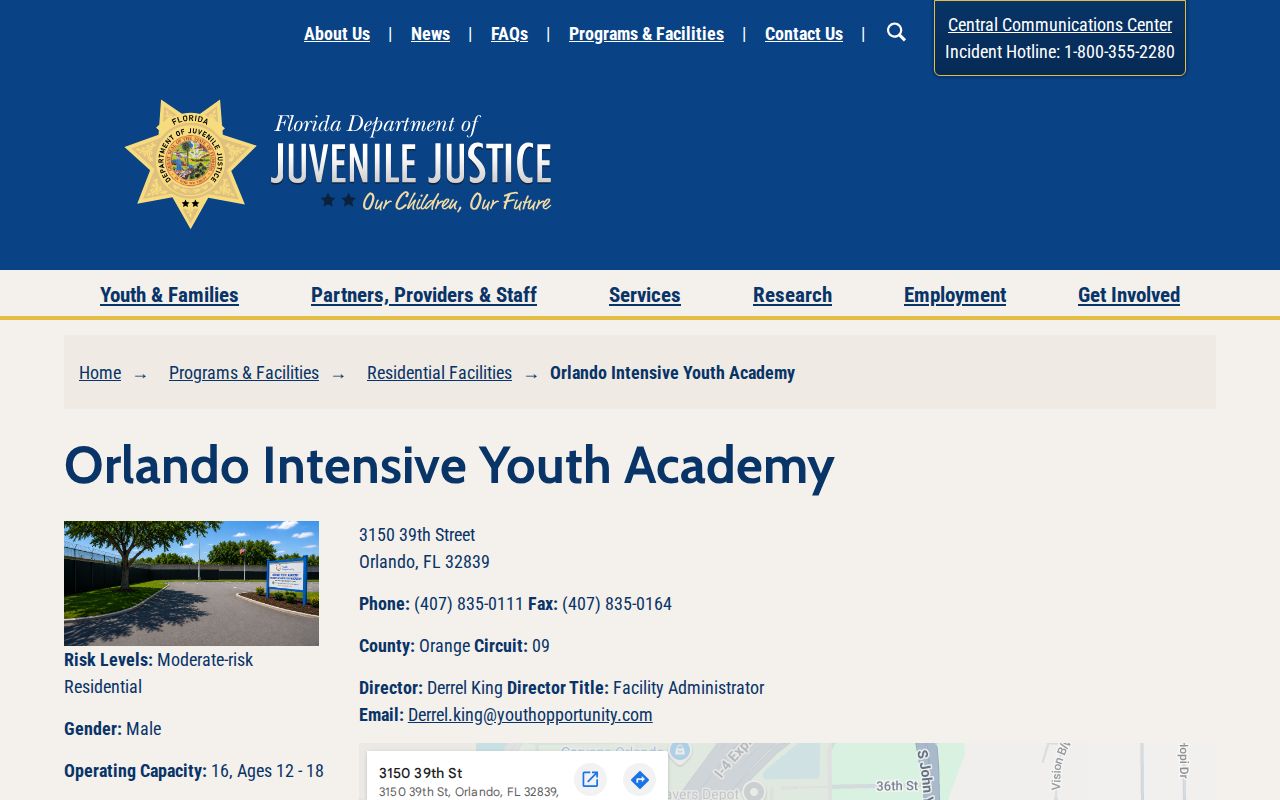
The profile is the right public source for program facts. It should not be turned into a roster. Capacity and age range describe whom the program is designed to serve, not who is present now, who completed the program, or when a specific youth will leave.
Moderate risk is DJJ program terminology. It does not mean the academy is an adult minimum-security prison. Residential commitment is governed through the juvenile case, treatment and case planning, DJJ authority, and the disposition order. That framework controls completion and movement.
Orlando Academy Placement Record Privacy
Florida Statutes §§ 985.04 and 985.045 generally protect juvenile information and official court records, while setting limited exceptions and authorized access. The result is a role-based process. A parent, legal custodian, attorney, DJJ official, court, or another person authorized by law may receive information suited to that role. The public does not receive a released-youth list.
The juvenile court-record access statute shows why an anonymous adult criminal docket search is not the right tool.
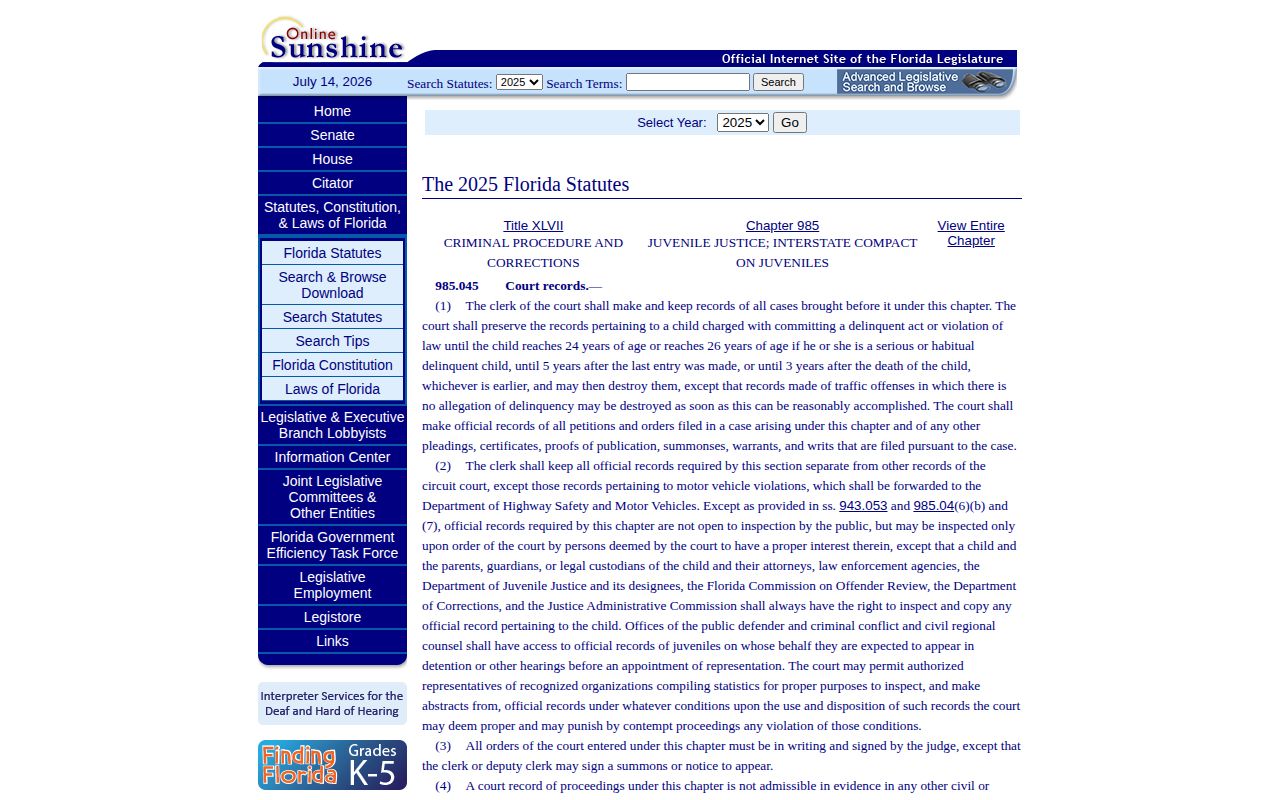
The access rule protects official juvenile court material from broad inspection. A missing public docket entry is not proof that no order exists. The authorized party should use counsel, the clerk route provided in the case, or the court itself to obtain permitted documents.
Requests should be narrow. Ask only for the program completion, movement, pickup, or supervision information needed for the youth's care and court process. Do not circulate images, names, addresses, dates of birth, or case allegations outside the authorized group.
Orlando Academy Completion Record Sources
There is no single public “release record” comparable to an adult jail event card. The useful juvenile record is a coordinated set of authorized documents: the disposition or later order, the DJJ case plan or official notice, and the program's operational completion or transfer communication. Each has a separate role.
| Authorized source | Question answered |
|---|---|
| Juvenile court order | What placement, change, or supervision the court authorized |
| DJJ case contact | Current status, case plan, destination, and transition responsibilities |
| Academy staff | Verified operational timing, approved recipient, and pickup steps |
| Receiving program | Whether a transfer or new placement was completed |
Dates should also be stated with care. A court may sign an order before transport occurs. A program may mark completion while a transition plan remains active. Aftercare can continue after the residential stay. Recording the source and meaning of each date avoids calling every milestone a final discharge.
A useful private chronology can list the disposition date, academy admission, review or modification orders, program completion, physical departure, receiving placement when one exists, and the start of aftercare. Each line should cite the DJJ notice or court record that supports it. This chronology helps an authorized family or attorney resolve conflicting dates without creating a public youth profile.
- Residential commitment
- A juvenile court-ordered placement in a DJJ program after disposition.
- Aftercare
- Structured support or oversight that may follow the residential phase.
- Transfer
- Movement to another approved setting while the juvenile case continues.
- Completion
- The end of the academy program phase, which may not end every court duty.
Trace Orlando Academy Release Outcomes
For a return to a parent or legal custodian, confirm that the recipient is named or approved and understands the next reporting duties. For movement to another program, verify the receiving placement through the assigned DJJ contact. For a court modification, obtain the authorized order and compare it with the program's operational notice. These steps protect the youth from a missed handoff and prevent a transfer from being mislabeled as complete release.
Adult and juvenile systems may touch the same family, but their records must remain separate. The Orange County adult release overview explains county, FDC, federal, and ICE paths. It does not authorize searching for a youth or applying an adult custody label to this academy.
When an authorized person cannot get a clear answer, counsel and the juvenile court are the escalation route. The question should stay specific: what order controls, what placement is active, who can receive the youth, and what duty follows the physical departure. That produces a useful answer without exposing confidential juvenile facts.
The operator and DJJ have different practical roles. Academy staff manage daily program operations and the approved handoff. DJJ and the court govern the legal placement and case status. Ask the facility about operational instructions, then ask the assigned DJJ professional or counsel about the legal effect. Keeping those questions separate reduces delay and avoids asking staff to interpret an order beyond their role.