
Orange Regional Youth Release Paths
Orange Regional Juvenile Detention Center is a hardware-secure Florida Department of Juvenile Justice detention center. It serves Orange, Osceola, and Seminole Counties. Secure detention is a short-term court-linked setting for youth who may be awaiting adjudication, disposition, or placement. It is not an adult county jail, even though the facility is in Orange County and holds people in secure custody.
A youth's departure can lead to several outcomes. The juvenile court may authorize return to a parent or other legal custodian. DJJ may arrange movement to another secure setting, a residential commitment program, or another placement named in the case. A transport between facilities is continued custody or placement, not a release to the community. The authorized recipient should ask for the exact destination and the court or DJJ authority governing the movement.
The public should not try to identify youths who leave the center. No public released-youth roster was documented. Person-specific details belong only in authorized communications. That rule protects the youth while still allowing a parent, custodian, counsel, DJJ, and the juvenile court to coordinate lawful pickup, transport, and case obligations.
Orange Regional Release Privacy
Florida Statutes §§ 985.04 and 985.045 set the central privacy boundary. Section 985.04 addresses confidentiality of juvenile records and information, subject to stated exceptions. Section 985.045 limits public inspection of official juvenile court records. These rules mean an adult-style name search, booking display, or released-person archive must not be built for Orange Regional Juvenile Detention Center.
The official juvenile confidentiality statute shows why access depends on legal role rather than curiosity. The statute and its exceptions should be read with counsel or the court when access is disputed.
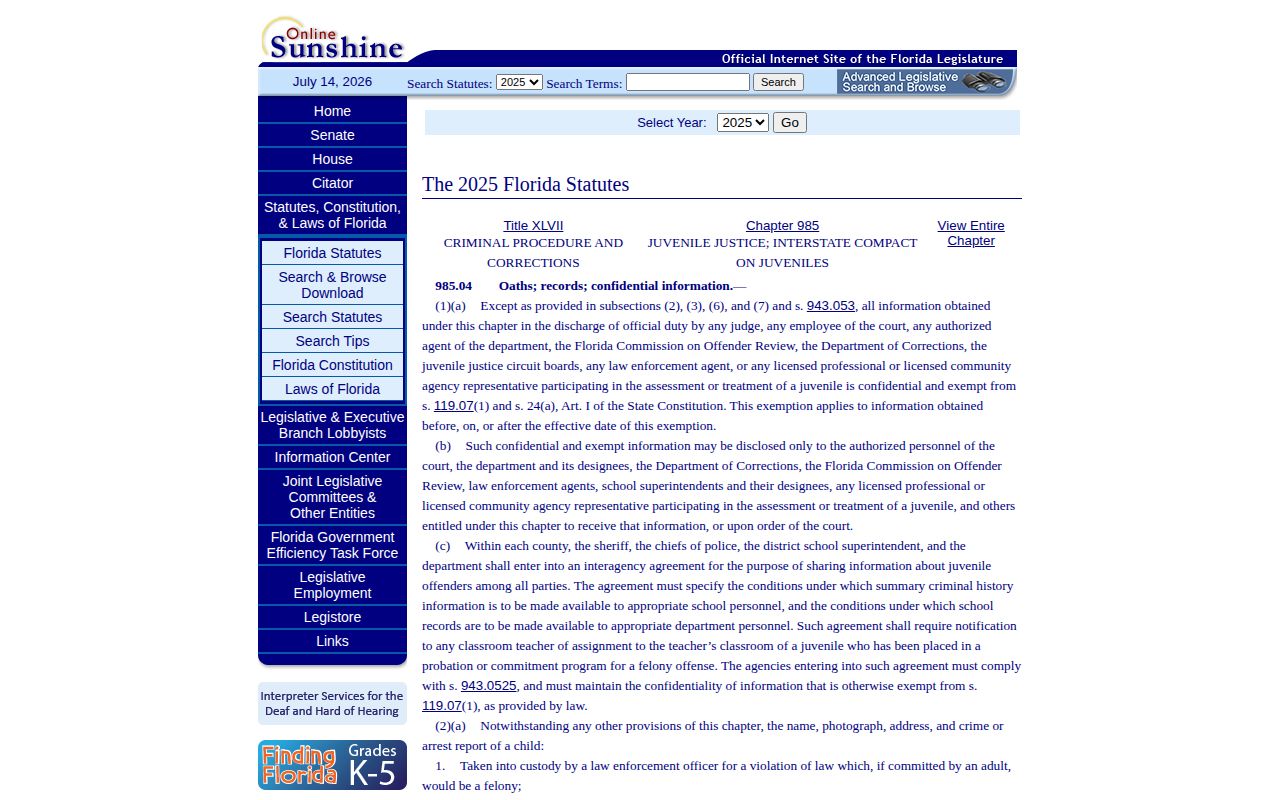
The statute view reinforces the narrow route used throughout Orange County: authorized people seek the specific information needed for care, representation, custody, or court process. It is not a source for publishing names, photographs, dates of birth, charges, addresses, or release destinations.
Confirm Orange Regional Release
An authorized parent or legal custodian should start with the case contact already assigned by DJJ or the court. Use the child's official case identifiers in a private exchange, not on an open page. Counsel can confirm the governing order and whether it permits return home, requires transport to a placement, or imposes another condition. Facility staff can confirm pickup and release instructions only to people whose identity and authority can be verified.
- Contact the assigned DJJ representative, attorney, or juvenile court office using the case information already provided to the authorized party.
- Confirm the exact court order, disposition, detention status, and planned destination. Ask whether the event is release to a custodian or movement to another program.
- Call the center through its official number and follow its identity-verification process. Do not send protected youth details through an unverified channel.
- Ask what identification, custody paperwork, pickup approval, and follow-up instructions the authorized recipient must bring.
- Keep the court order and DJJ communication together. They show legal authority and the operational release plan.
BestJail is not part of this path. It covers current adult Orange County Corrections custody and removes adults on release. FDC's adult offender searches cover state prison and adult community supervision. Neither system should be used to draw a conclusion about a youth at Orange Regional.
VINE is also not a substitute for the juvenile case route documented for this center. Orange County's public VINE page describes adult county custody notifications, and the statewide service depends on participating agency feeds. No research source established a public Orange Regional released-youth result. An authorized person should rely on the assigned DJJ contact and court order, even if an adult search tool returns no match.
Note: A youth moved to a commitment program has left detention, but has not necessarily completed DJJ custody or court supervision.
Orange Regional Release Contact
The facility's official DJJ profile supplies the public contact point and confirms its regional role. A call may establish how an authorized custodian should reach the assigned team, but staff should not disclose protected case details merely because a caller knows a name. Be ready to verify identity and legal authority through the process the center provides.
Orange Regional Juvenile Detention Center
Operator: Florida Department of Juvenile Justice
Address: 2800 South Bumby Avenue, Orlando, FL 32806
Phone: 407-897-2800
Service area: Orange, Osceola, and Seminole Counties
The location has a regional mission. A youth's home county, placing court, assigned DJJ staff, and lawful custodian may not all be the same office. Ask which circuit or court file controls the next step. That prevents an Orange County address from being mistaken for proof that every case belongs to Orange County court.
Orange Regional Detention Role
The official DJJ facility profile identifies Orange Regional as a secure detention center and gives its location, contact, service counties, and capacity.
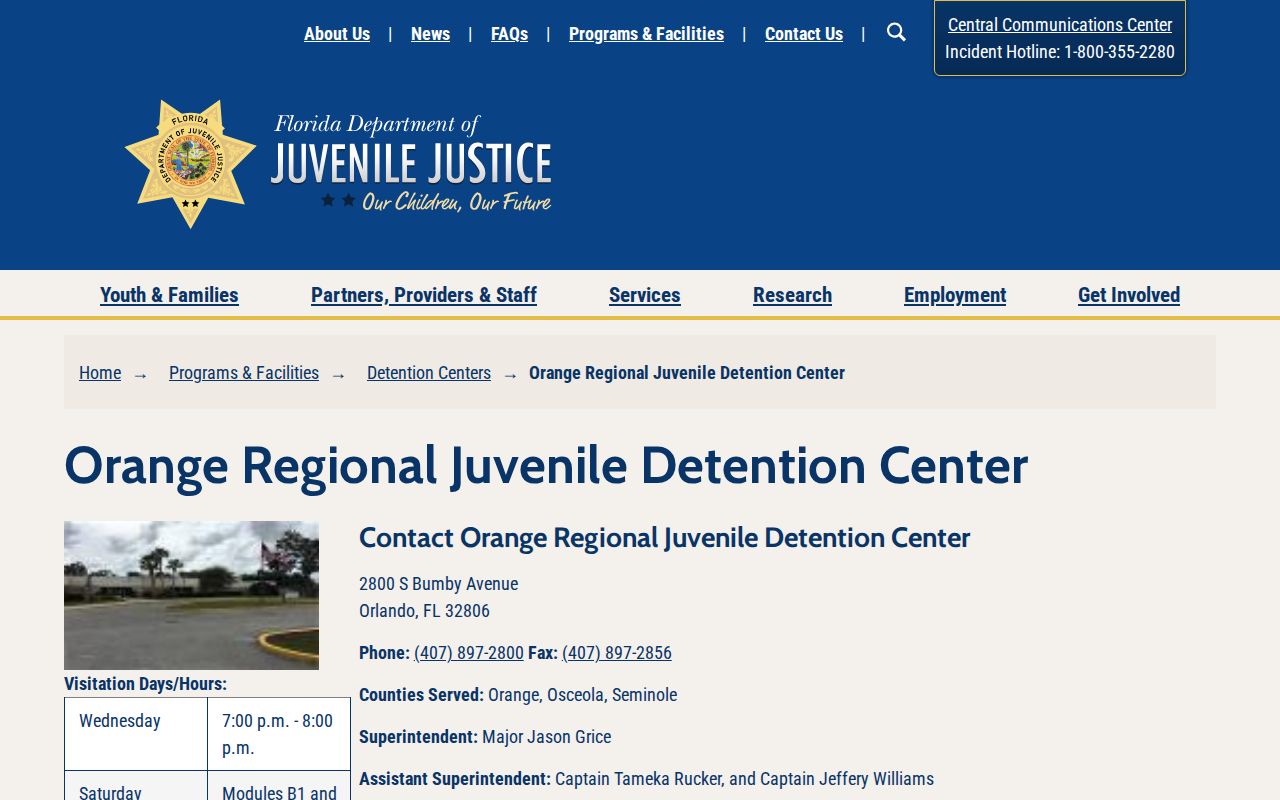
The official profile distinguishes this center from both an adult jail and a residential commitment academy. Secure detention may hold a youth while a case proceeds or while placement is arranged. Residential commitment follows a different court disposition and program structure. That distinction determines which staff, case plan, and order govern departure.
Capacity describes the facility, not the number of youth present or released. No release volume was documented. It would be wrong to convert the bed count into a release estimate or to infer case outcomes from the population size.
Orange Regional Court Records
The juvenile court order and the DJJ custody action answer different questions. The order states what the court authorized. DJJ and facility staff carry out the detention, placement, transport, and release plan. An authorized person may need both sources to confirm when the change occurred and what obligations remain.
Electronic court access is limited for juvenile matters. A missing public result does not show that no case or order exists. Section 985.045 explains the restricted inspection framework, and the clerk or court determines access under the law. An attorney can request material through the case. A parent or custodian should use the route supplied by the court rather than trying an anonymous adult criminal search.
Authorized access should remain proportional to the need. A custodian arranging pickup may need the effective order, release instructions, destination, and next appointment. Counsel may need a fuller case record. A member of the public does not gain the same access merely by knowing a youth's identity. The court and DJJ apply the statute to the requester's role and the record category.
- Adjudication
- The juvenile court's determination on the allegations in the case.
- Disposition
- The juvenile court's order for services, supervision, detention, or commitment after adjudication.
- Detention
- Secure or supervised custody used during a juvenile case under court and statutory rules.
- Commitment
- A court-ordered DJJ residential placement, distinct from short-term secure detention.
Trace Orange Regional Placement
Use destination words with care. “Returned to parent” or “released to legal custodian” describes a community handoff authorized in the case. “Transferred,” “placed,” or “committed” generally signals that a structured setting continues. “Case closed” may refer to a court status, but it should not be guessed from a facility departure. Ask the assigned professional for the exact term in the order.
| Departure path | Best confirmation |
|---|---|
| Return to authorized custodian | DJJ release instructions plus juvenile court authority |
| Move to another detention center | DJJ transport and receiving-facility confirmation |
| Residential commitment placement | Disposition order, DJJ case contact, and program intake |
| Court-directed change | Authorized access to the signed juvenile court order |
There is no lawful need to publish a youth's identity to verify one of these paths. The responsible approach keeps names and case facts inside authorized channels. If access is denied, counsel or the court can address the person's legal standing without opening confidential details to the public.
Transportation and handoff details should also stay private. The approved recipient can confirm where to report, what identification to bring, who will make the handoff, and which conditions begin next. Publishing that route could expose a protected youth and is not required to explain how the Orange Regional release process works.
The adult Orange County release-record overview is useful only for understanding why custody systems differ. Its BestJail and FDC lookup steps do not apply to this juvenile center.