
Orange Projected Versus Actual Release
A projected date answers when a current sentence is expected to end under the data and credits recorded now. An actual release date records the completed event. FDC's public interface labels a future value “Current Release Date,” while Florida Statutes § 944.275 calls the gain-time calculation a tentative release date. A completed FDC record instead shows “Release Date.”
Orange County jail records use a separate county-sentence framework. Bond, dismissal, a new court order, an added hold, or a transfer can end or extend county custody without following an FDC calculation. A person awaiting trial often has no fixed sentence-expiration date at all.
Find an Orange County Release Date
Start with the agency that holds the person today. BestJail covers current Orange County adult jail custody. FDC covers Florida state-prison custody. Juvenile, federal, and immigration custody use different channels and should not be forced into either calculation.
- Check Orange County BestJail to determine whether the person is currently shown in the county jail and record the booking number, charges, and bond details.
- Read the Orange Clerk case for the signed bond order, sentence, jail credit, commitment, or later modification.
- For a county jail sentence, request the sentence computation and current projected date from Orange County Corrections. Do not apply a statutory maximum credit on your own.
- For a state prisoner, open the FDC Offender Search, select the current population or inmate release database, and search by DC number.
- Verify the public date label, sentence structure, offense dates, incarceration history, and any listed supervision.
- After the expected date, switch to the executed county event or FDC inmate release result and check any receiving agency.
A county roster disappearance does not reveal whether the person entered the community or moved to FDC, USMS, or ICE. The Orange County released-inmate records hub gives the full receiving-agency check when the direction is unclear.
FDC Orange County Date Labels
FDC establishes a maximum sentence expiration date from the imposed term, lawful jail credit, and sentence structure. Eligible, awarded gain-time can move the tentative date earlier within statutory limits. The public screen presents the current calculated value, but its warning makes clear that gain-time awards, forfeitures, and review can change it.
| FDC field or term | Meaning | How to use it |
|---|---|---|
| Current Release Date | Public label for a future or scheduled FDC date | Recheck because it can change |
| Tentative release date | Statutory term for the gain-time calculation | Use when explaining § 944.275 |
| Maximum sentence expiration date | Sentence framework before eligible gain-time moves the date | Do not confuse it with the public projected field |
| Release Date | Completed release shown in a past FDC result | Verify the actual state-custody event |
| Supervision termination | Expected end of a community-supervision term | Not the same as prison release |
The official FDC example result shows the public Current Release Date label and the review warning.
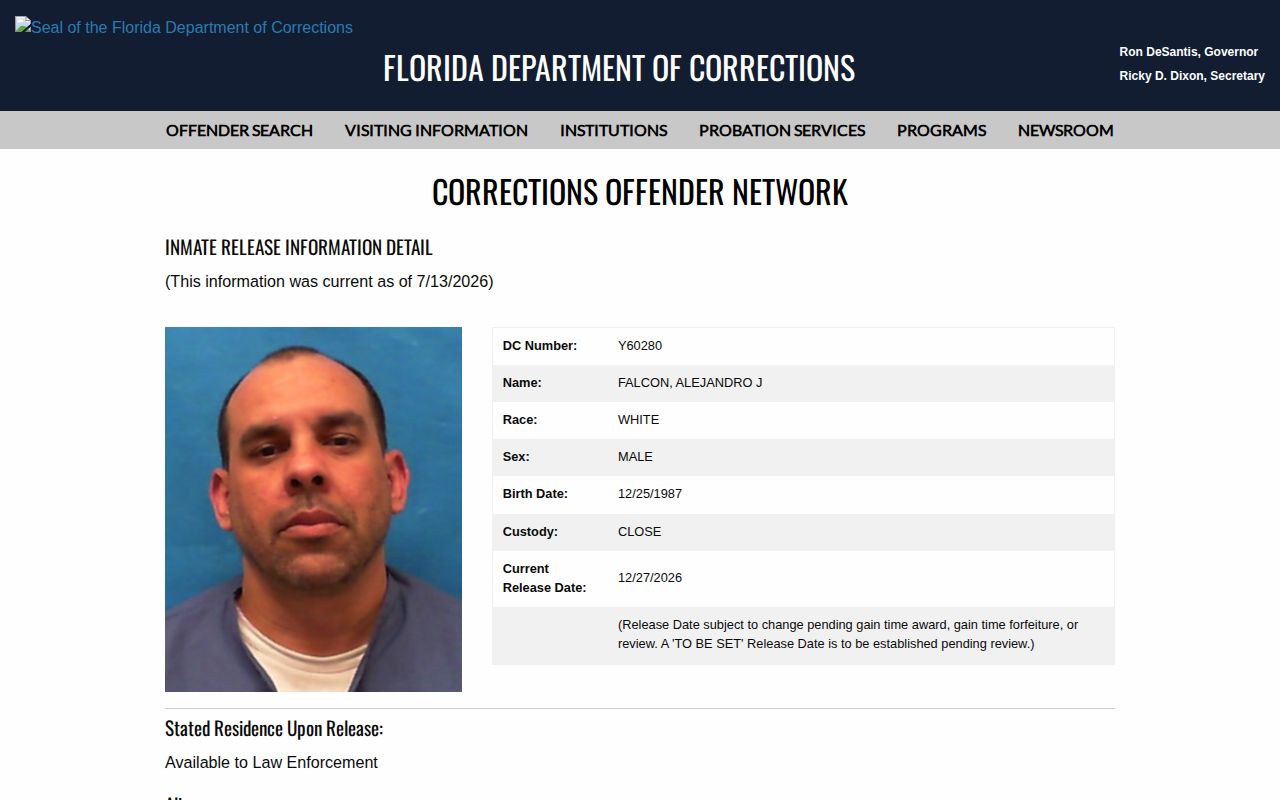
This state-prison record should not be used to calculate a sentence served only in the Orange County jail.
Florida State Prison Gain Time
Florida Statutes § 944.275 sets the modern state-prison framework. Court-awarded credit for time physically incarcerated counts toward satisfaction of the 85-percent service requirement. Except for statutory exceptions, other gain-time cannot move the tentative date earlier than the point at which 85 percent of the sentence has been served.
The figure is a floor for a covered cohort, not a calculator for all prisoners. Offense dates, mandatory minimums, life sentences, statutory exclusions, and specified serious offenses can produce different outcomes. The law also preserves different gain-time rules for older offense-date groups. A simple multiplication ignores those factors and may be wrong.
The official gain-time statute shows those limits and definitions.
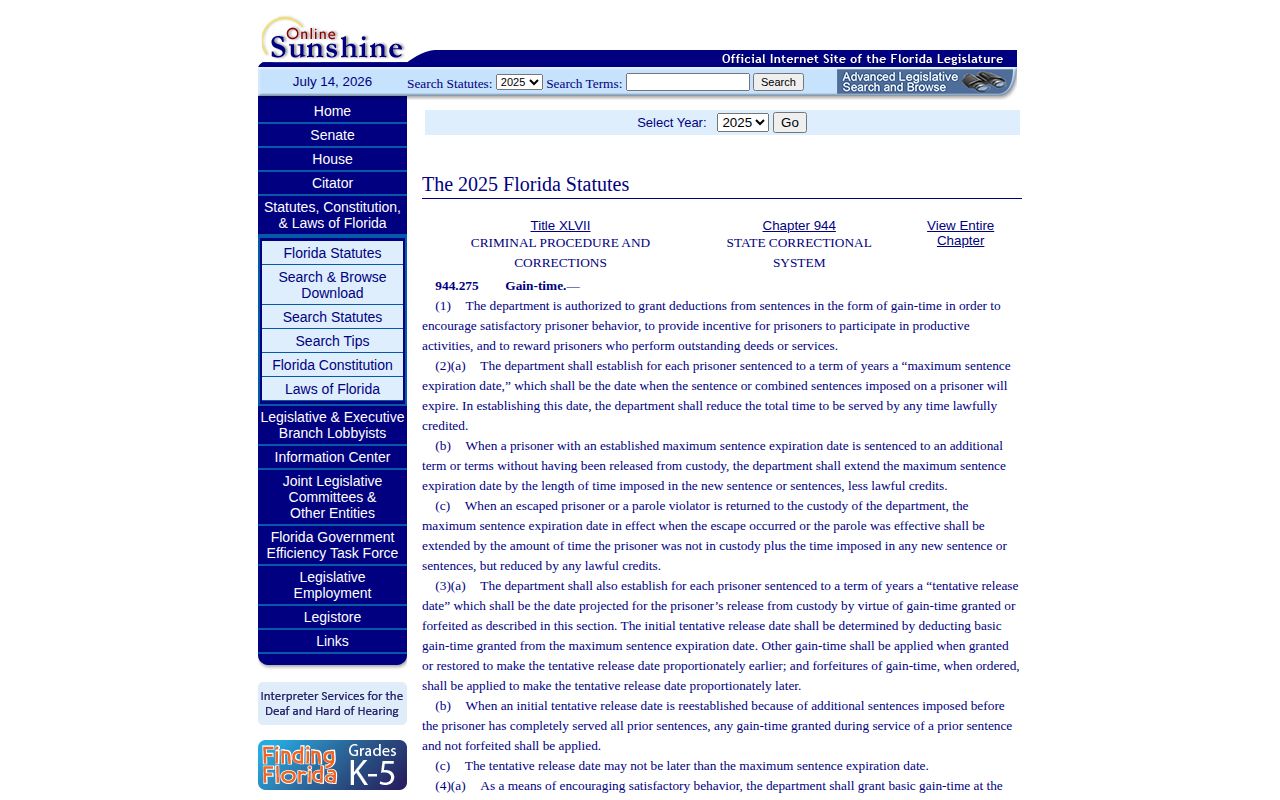
The controlling date remains the value in FDC's individual record, not an estimate made from sentence length alone.
Calculate Orange State Prison Dates
A safe conceptual sequence begins with the imposed term or terms. FDC applies lawful jail credit and the court's concurrent or consecutive sentence structure to establish the maximum-expiration framework. Eligible gain-time that is actually awarded may then move the tentative date earlier, subject to the service floor and any more restrictive statute. This sequence explains the record, but it is not a public calculator.
Offense dates are essential because Florida preserved different basic and incentive gain-time rules for older cohorts. The statute treats the period before 1994, parts of 1994 and 1995, and the modern cohort differently. Some offenses are excluded from categories of credit, and a mandatory minimum may require service beyond a general percentage. Escape time, a new sentence, or corrected court credit can also alter the framework.
Life sentences require separate treatment. They should never be assigned a date by multiplying a term or applying the 85-percent floor. When the public FDC result supplies a Current Release Date, use that label and its warning. When it does not, seek the official sentence calculation rather than creating one.
After the date becomes past, search the FDC inmate-release database. The completed Release Date records departure from state custody, while the incarceration history helps distinguish discharge from an earlier transfer between prisons. Then check community supervision and any receiving county, federal, or immigration system if the facts point to continued custody.
Orange County Jail Gain Time
A sentence served in the Orange County jail is not governed by FDC's 85-percent rule. Florida Statutes § 951.21 authorizes county good-conduct commutation under county policy and sets maximum monthly deductions if granted. The statute allows up to five days per month in the first and second years, ten in the third and fourth years, and fifteen in the fifth and later years. Earned credit can be forfeited.
Those maximums do not prove what any Orange County prisoner received. Classification, discipline, eligible activity, documented participation, and the county's administration determine the real sentence calculation. Ask Orange County Corrections for the individual computation and cite the court sentence and booking number.
Orange County Code Date Rules
Orange County Code § 26-1 adds a distinctive local layer. It retains statutory good-conduct credit and authorizes work, constructive, and program gain time. Constructive credit can address a qualifying inability to work or participate. Program credit depends on faithful participation in an approved program.
The three additional categories cannot overlap for the same period. An Orange County jail date therefore depends on personal classification, actual participation or documented inability, discipline, and the credits entered by Corrections. It cannot be reproduced with FDC's formula or the maximum county schedule.
| Orange County factor | Possible effect | Proof source |
|---|---|---|
| Good conduct | Eligible statutory credit | Corrections sentence computation |
| Work participation | Local work gain time when awarded | Program and classification record |
| Constructive credit | Credit for a qualifying documented inability | Corrections documentation |
| Program participation | Local program gain time when earned | Approved program record |
| Discipline | Forfeiture or loss of eligible credit | Institutional record |
Note: Orange County's local code makes the jail calculation person-specific, so a public sentence length alone cannot establish the exit date.
Compare Orange Release Calculations
A county booking can lead to several date systems. A person awaiting trial may have a bond condition or next hearing but no sentence-release date. A person serving a county sentence may have Orange County good-conduct, work, constructive, or program credit. A person transferred to FDC moves into the state-prison framework. The county transfer date is not the FDC discharge date.
Community placement also needs care. Work release permits authorized movement while county authority continues. FDC community or reentry placement may allow activity outside a secure prison while state authority remains. Probation, parole, and conditional release place a person outside prison under conditions. The expected end of supervision is not the same field as release from jail or prison.
Use the court order to define the sentence, the holding agency to obtain the current projection, and the release record to confirm the event. If the systems disagree, compare the case number, booking number, DC number, offense date, credit order, and update time before asking the agency that owns the disputed calculation to review it.
Why Orange Release Dates Change
Both court and corrections data can change the date. The key is to identify whether a change affects the sentence itself, the credit calculation, or what happens after release.
| Change | Effect on the date | Record to check |
|---|---|---|
| Gain-time award or forfeiture | Moves the current projection within legal limits | FDC or county computation |
| Corrected jail credit | Changes time credited toward the sentence | Court order and agency record |
| Concurrent or consecutive structure | Changes how multiple terms combine | Judgment and sentence |
| New sentence or mandatory minimum | Can extend or restrict an earlier projection | Court docket and offender record |
| Detainer or hold | May transfer the person instead of producing community release | Release event and receiving agency |
| Parole or Commission action | Can authorize, delay, modify, or revoke release | FCOR final order and FDC result |
| Administrative review | Corrects data or legal eligibility | Current official calculation |
Life sentences and many mandatory terms cannot be reduced to a general percentage. When a date changes, the official current record and the order behind the change control.
Orange County Release-Day Timing
All adult Orange County jail releases leave through the public lobby of the Booking and Release Center. The county does not promise a fixed release hour. Staff must verify the legal authority, clear warrants and holds, move the person through the complex, return stored property, and complete final processing.
Florida Statutes § 951.04 says a qualifying county prisoner discharged after sentence completion, pardon, or parole receives transportation or its money equivalent back to the place of sentence. The law does not document the exact form Orange County uses in each case. Inmate Records Management can explain local implementation without promising a specific ticket or cash amount.
Confirm Orange County Actual Release
After the scheduled date, check the completed record. For county custody, request actual release date and time, reason, authority, and destination from Corrections. For state prison, use the FDC inmate release search. If either record shows transfer, follow the receiving agency instead of describing the person as free.
VINE can send a prompt custody-change alert, but it is not a certified archive. The Orange Clerk docket explains the legal order, while Corrections or FDC shows the executed event. The Orange County VINE Inmate Check covers registration and local feed timing.
Recheck the current agency record for a changed calculation, hold, new sentence, review, or transfer. The old projected date is not proof of release.